1 / 1

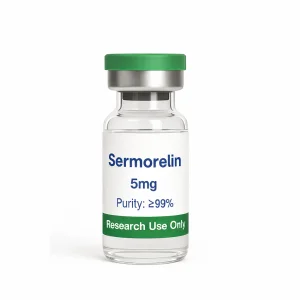
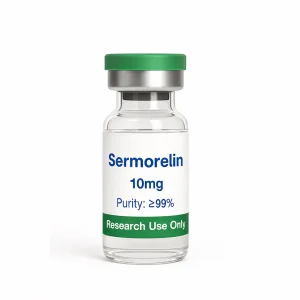
Sermorelin is a synthetic 29–amino acid peptide corresponding to the biologically active fragment of growth hormone–releasing hormone (GHRH). Structurally defined as GHRH (1–29)-amide, it represents the shortest known synthetic peptide that may retain functional activity at GHRH receptors.
Due to its close structural and functional similarity to endogenous GHRH, Sermorelin has been widely studied in growth hormone deficiency and endocrine regulation research models.
Initial investigations into Sermorelin began in the early 1980s, when the peptide—then classified as growth hormone–releasing factor (GHRF 1–29) amide—was examined in rodent models. Studies involving both conscious and anesthetized rats reported stimulation of pituitary activity and enhanced growth responses following exogenous administration.
These findings led to broader interest in Sermorelin and related analogs as experimental tools for exploring growth hormone regulation.
Sermorelin is believed to bind selectively to GHRH receptors located on pituitary somatotroph cells. Upon receptor interaction, it is hypothesized to initiate intracellular signaling pathways that include:
Released hGH may subsequently stimulate the synthesis of insulin-like growth factor-1 (IGF-1). Despite its shortened amino acid sequence relative to native GHRH, Sermorelin is thought to preserve the core biological functionality of the parent hormone. Its estimated plasma half-life is approximately 11–12 minutes.
Due to its receptor specificity, Sermorelin is suggested to have minimal impact on other endocrine markers. Research indicates no significant alterations in:
This selective activity has contributed to its continued investigation in endocrine research settings.
In experimental models of idiopathic growth hormone deficiency, sustained exposure to Sermorelin has been associated with increased growth velocity and height gain. Some studies report observable effects within 12 months, with maintained responses during continued exposure.
Preliminary research suggests that Sermorelin may significantly elevate average growth hormone levels for extended periods. In a 16-week study, investigators reported:
These effects are hypothesized to result from enhanced GH-IGF-1 signaling.
In a controlled study involving HIV-positive subjects with lipodystrophy, participants exposed to Sermorelin demonstrated:
No significant changes in glucose or insulin levels were reported.
Research examining age-related declines in growth hormone secretion has explored potential correlations with cognitive performance. In studies involving elderly subjects, Sermorelin exposure was associated with improved outcomes on components of the Wechsler Adult Intelligence Scale (WAIS), including verbal and visual processing measures.
In a large-scale in vitro screening study involving glioma cell lines, Sermorelin exhibited a high sensitivity response score relative to other compounds. Researchers proposed that this effect may be related to modulation of tumor cell cycle activity, potentially influencing proliferation dynamics.
Early investigations explored whether Sermorelin could influence gonadotropic hormone release. Experimental findings suggested stimulation of follicle-stimulating hormone (FSH) and luteinizing hormone (LH), which may indirectly affect testosterone production.
Subsequent studies in younger and older male subjects reported increases in testosterone levels, although these changes were not consistently statistically significant. Growth hormone secretion was observed to peak predominantly during nighttime periods.
Sermorelin is a synthetic 29-amino acid peptide corresponding to the biologically active fragment of growth hormone–releasing hormone (GHRH 1–29-amide).
It binds selectively to GHRH receptors on pituitary somatotroph cells, activating intracellular pathways that lead to the pulsatile secretion of endogenous human growth hormone (hGH).
The estimated plasma half-life of Sermorelin is short, lasting approximately 11 to 12 minutes.
No, research indicates high endocrine selectivity with no significant alterations in prolactin, insulin, cortisol, blood glucose, or thyroid hormones.
Sermorelin has a molecular formula of C₁₄₉H₂₄₆N₄₄O₄₂S, a molecular weight of 3357.93 g/mol, and is alternatively known as GRF 1-29.
Sermorelin is investigated across growth velocity models, anabolic and lipodystrophy research, cognitive function assessments, tumor cell cycle dynamics, and hypogonadism-related endocrine models.