Explore our top-tier active pharmaceutical ingredients synthesized under strict analytical and cGMP regulatory standards.
A comprehensive analytical review of Tesamorelin synthesis standards, molecular stability, and batch-to-batch consistency requirements in modern peptide manufacturing.
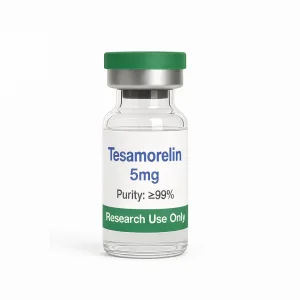
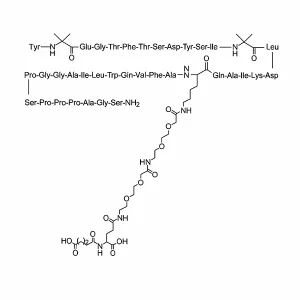
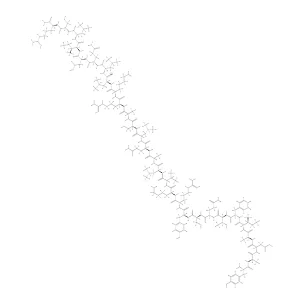
Tesamorelin (CAS No. 218949-48-5) is a synthetic 44-amino acid N-terminal modified analogue of human Growth Hormone-Releasing Factor (GRF/GHRH). By featuring a hexenoyl group attached to its N-terminal tyrosine residue, Tesamorelin demonstrates enhanced enzymatic resistance against Dipeptidyl Peptidase-4 (DPP-4) degradation, resulting in a prolonged physiological half-life compared to native GHRH(1-44).
The primary mechanism revolves around binding specifically to GHRH receptors on pituitary somatotrophs, inducing endogenous, pulsatile growth hormone (GH) release without disrupting feedback inhibition loops of Insulin-like Growth Factor 1 (IGF-1). High-grade Tesamorelin 10mg lyophilized vials manufactured in standardized automated facilities guarantee precision stoichiometry, ensuring minimal truncated peptide impurities during research and therapeutic batch formulation.
For commercial biopharmaceutical applications, achieving ultra-high purity is paramount. Leading manufacturing facilities utilize advanced Reverse-Phase High-Performance Liquid Chromatography (RP-HPLC) coupled with Electrospray Ionization Mass Spectrometry (ESI-MS) to audit every production run.
| Specification Parameter | Analytical Test Method | Acceptance Criteria (Commercial Grade Tesamorelin 10mg) |
|---|---|---|
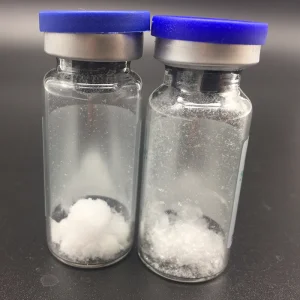
| Appearance | Visual Inspection | White to off-white, sterile lyophilized powder free of foreign matter |
| Identity / Mass Spectrum | ESI-MS / MALDI-TOF | 5135.9 Da ± 1.0 Da (Matches Theoretical Sequence) |
| Peptide Purity (Chromatographic) | RP-HPLC (C18 Column) | ≥ 99.0% (Single individual impurity ≤ 0.5%) |
| Peptide Content (N-content) | Elemental Analysis / UV | ≥ 85.0% active peptide content |
| Moisture Content (Karl Fischer) | Coulometric Titration | ≤ 5.0% w/w |
| Endotoxin Control | LAL Kinetic Chromogenic Method | < 0.05 EU/mg (Suitable for parenteral clinical formulations) |
Information Gain Insight: Unlike standard peptide vendors, certified Tesamorelin 10mg factories implement multi-stage counter-ion exchanges during preparative chromatography. Converting crude TFA salts to pharmaceutical-grade acetate or chloride salts eliminates cytotoxic interference during cellular bioassays and enhances long-term lyophilized shelf life.
Examining the structural, economic, and technological advantages that make Chinese peptide manufacturing plants world leaders in scalable API production.
Leading Chinese chemical groups maintain massive infrastructure designed specifically under international cGMP standards. With overall factory construction areas spanning over 250,000 square meters, facilities integrate fully automated microwave-assisted Solid-Phase Peptide Synthesizers (SPPS) alongside industrial liquid-phase reaction vessels, enabling seamless transition from gram-scale R&D to metric-ton commercial output.
China commands over 70% of the world's upstream raw material production for peptide synthesis, including high-purity protected amino acids (Fmoc/Boc derivatives), coupling reagents (HATU, HBTU, PyBOP), and specialized resins (Wang, Rink Amide). This vertical integration insulates buyers from global raw material supply shocks while significantly lowering baseline production costs for Tesamorelin 10mg.
Modern Chinese factories operate under strict oversight, aligning operations with US FDA cGMP, EU GMP, ISO 9001:2015, and ISO 13485 quality systems. Full batch traceability, digital environmental controls in Class 10,000 (ISO 7) cleanrooms, and automated freeze-drying units guarantee consistent cake morphology and reconstitution solubility for every batch of Tesamorelin 10mg produced.
Key market drivers shaping the demand for targeted GHRH analogues, therapeutic peptides, and contract manufacturing alliances.
The biopharmaceutical landscape is undergoing a massive pivot toward targeted hormonal regulators. Growth hormone secretagogues and GHRH analogues such as Tesamorelin 10mg lead this domain due to their precision action on visceral adipose tissue reduction and metabolic dysfunction management without triggering systemic hyperinsulinemia.
Leading peptide factories are adopting artificial intelligence to optimize coupling reaction cycles, minimize solvent consumption (green peptide synthesis), and predict peptide aggregation during synthesis. This automation drastically elevates single-batch purity levels while reducing synthesis timelines by up to 40%.
Biotech firms in North America and Europe are increasingly divesting from high-CAPEX synthesis facilities, choosing instead to collaborate with specialized Contract Development and Manufacturing Organizations (CDMOs) in Asia. This shift accelerates clinical trial timelines through turnkey batch production and regulatory dossier compilation (DMF/CEP).
Enhanced global cold-chain infrastructure—incorporating real-time IoT temperature sensors and vacuum-insulated packaging—ensures that sensitive 10mg lyophilized peptide vials reach international destinations without thermal degradation or bioactivity loss.
Tailored biopharmaceutical frameworks supporting multi-sector healthcare, clinical research, and commercial licensing.
Tesamorelin 10mg is utilized extensively in institutional clinical trials investigating body composition modulation, peripheral fat redistribution, and liver lipid accumulation (NAFLD/NASH models). High batch-to-batch reproducibility is critical for obtaining unskewed physiological data across multi-center studies.
For international pharmaceutical firms seeking rapid market entry, turnkey Finished Dosage Form (FDF) licensing services provide completed stability data, process validation, and tech transfer dossiers. This turns complex peptide drug manufacturing into an off-the-shelf procurement option.
Factories provide fully customized manufacturing solutions—ranging from dual-chamber cartridge loading to specialized vial sizing (e.g., 2mg, 5mg, 10mg lyophilized vials). Contract packaging, custom labeling, and multi-lingual documentation ensure alignment with regional regulatory mandates.
Eliminating supply chain complexity through consolidated procurement solutions, transparent documentation, and localized international support.
Navigating multiple vendors for raw materials, peptide synthesis, analytical validation, and sterile lyophilization introduces major risk and operational delays. Integrated sourcing solutions offer enterprise procurement teams a single, highly reliable point of contact.
Gentolex’s core objective is creating opportunities connecting global buyers with guaranteed pharmaceutical products and specialized technical support. Having served customers across more than 10 countries, Gentolex has established dedicated international representative offices, notably in Mexico and South Africa.
Our core services encompass supplying high-purity peptide APIs, Custom Peptides, FDF licensing out, Technical Support & Consultation, Complete Product Line and Lab Setup, as well as customized Sourcing & Supply Chain Solutions.
Connecting global biopharmaceutical markets with reliable peptide manufacturing, research ingredients, and laboratory construction services.


Gentolex offers an extensive range of APIs and intermediates for development study and commercial application with cGMP standard from long-term collaborations. For clients who prefer to avoid dealing with multiple points of contact, we provide extra customized procurement services backed by superior supply chain sources and automated 250,000 sqm factory facilities.

Selank Acetate API is a synthetic heptapeptide active pharmaceutical ingredient composed of the sequence Thr-Lys-Pro-Arg-Pro-Gly-Pro. Developed for specialized neuropharmacological applications...
View Details
Providing high-quality Thymosin Beta-4 peptide API solutions for biotechnology companies, pharmaceutical research organizations, and academic centers worldwide...
View Details
BPC-157 API is a synthetic pentadecapeptide investigated for tissue repair, gastrointestinal bio-protection, and inflammatory regulation models...
View Details
Investigating synthetic neuroactive peptides derived from ACTH fragments. High purity synthetic quality guaranteed for neuroscience applications...
View Details
SS-31 API (Elamipretide, MTP-131) is a synthetic mitochondria-targeting tetrapeptide designed to stabilize cardiolipin in inner mitochondrial membranes...
View DetailsExpert answers regarding Tesamorelin 10mg manufacturing, analytical validation, storage, and custom ordering.
In its lyophilized (freeze-dried) powder form, Tesamorelin 10mg should be stored at -20°C to -80°C for long-term stability (up to 24-36 months). It can tolerate ambient temperatures during short-term cold-chain express shipping (up to 7 days) if protected from moisture and direct light exposure. Once reconstituted with Bacteriostatic Water or Sterile Normal Saline, the solution must be refrigerated at 2°C to 8°C and used within 14-28 days depending on the preservative used.
Synthesizing long-chain peptides like Tesamorelin (44 residues with an N-terminal hexenoyl modification) requires automated Solid-Phase Peptide Synthesis (SPPS) using highly optimized coupling cycles. Factories utilize microwave-assisted reactors to prevent beta-sheet aggregation during sequence elongation. Furthermore, preparative HPLC purification and rigorous batch testing via HPLC and Mass Spectrometry guarantee that every batch meets standard chemical purity specifications exceeding 98.0%.
Yes. Factories offer dual delivery pathways: unformulated bulk lyophilized API powder (packaged in sterile sealed glass flasks or amber bottles) for pharmaceutical re-formulation, or fully finished OEM/ODM 10mg vials filled, freeze-dried, stoppered, and crimped in Class 100 (ISO 5) aseptic suites.
Every commercial lot is accompanied by a full Certificate of Analysis (CoA) containing RP-HPLC chromatograms (purity verification), ESI-MS spectra (molecular weight identification), Karl Fischer titration data (residual moisture content), LAL endotoxin testing results (<0.05 EU/mg), and residual solvent analysis (GC-Headspace).
While standard synthesis yields peptide trifluoroacetate (TFA) salts, factories can execute salt exchange steps to deliver Acetate (AcOH) or Hydrochloride (HCl) salt forms. Acetate counter-ions are generally preferred for biological research and formulation due to reduced cellular toxicity.
MOQs vary depending on whether you require bulk API powder or finished lyophilized 10mg vials. Standard bulk powder orders typically start at 10 grams, whereas custom OEM vial production runs typically require a minimum batch of 100 to 500 vials to optimize cleanroom filling costs.
Browse our comprehensive list of active pharmaceutical ingredients, research compounds, and custom formulations.