Explore our industrial-scale active pharmaceutical ingredients (APIs), custom peptides, and chemical intermediates exported globally.

In the modern landscape of fine chemical synthesis and pharmaceutical intermediate production, halo-substituted benzaldehyde derivatives serve as fundamental molecular scaffolds. Among these, 2-Bromo-5-Chlorobenzaldehyde (CAS No. 156682-53-0 / 95267-27-3) occupies a pivotal position due to its dual halogen functionality and reactive formyl group. This structural architecture permits highly regioselective cross-coupling chemistry, enabling organic synthesis chemists and industrial manufacturing plants to construct complex heterocyclic frameworks, active pharmaceutical ingredients (APIs), targeted crop protection chemicals, and next-generation optoelectronic materials.
As global supply chains demand higher quality standards, stringent impurity profiling, and robust compliance with international regulatory frameworks (such as REACH, cGMP, and ISO 9001:2015), establishing direct partnerships with qualified wholesale factories and primary exporters becomes paramount. This technical whitepaper offers a comprehensive analysis of 2-Bromo-5-Chlorobenzaldehyde, covering its chemical characteristics, industrial synthesis pathways, global commercial trends, localized application scenarios, and macro supply chain dynamics.
Chemical Formula: C7H4BrClO | Molecular Weight: 219.46 g/mol | Appearance: Off-white to pale yellow crystalline powder | Assay (HPLC): ≥99.0% (Custom high-purity grades up to 99.8%) | Melting Point: 54.0 °C to 58.0 °C | Boiling Point: 248.5 °C at 760 mmHg | Solubility: Soluble in organic solvents (Chloroform, Methanol, Ethyl Acetate, Dichloromethane); insoluble in water.
| Analytical Parameter | Standard Commercial Specification | Ultra-Pure API Grade Specification | Testing Methodology |
|---|---|---|---|
| Chemical Purity | ≥ 98.5% (Area Percent) | ≥ 99.5% (Area Percent) | High-Performance Liquid Chromatography (HPLC) |
| Individual Impurity | ≤ 0.5% | ≤ 0.10% | HPLC-MS / GC-MS Profile |
| Water Content (Karl Fischer) | ≤ 0.50% | ≤ 0.10% | Coulometric Karl Fischer Titration |
| Residue on Ignition | ≤ 0.20% | ≤ 0.05% | Gravimetric Analysis (USP <281>) |
| Heavy Metal Residues | ≤ 20 ppm | ≤ 5 ppm | ICP-MS (Inductively Coupled Plasma Mass Spectrometry) |
| Identity Verification | Conforms to Structure | Conforms to Structure | 1H-NMR, 13C-NMR, & FT-IR Spectroscopy |
The commercial demand for 2-Bromo-5-Chlorobenzaldehyde is experiencing accelerating growth on a global scale, propelled primarily by advancements in targeted small-molecule oncology drug development, next-generation agricultural crop protection agents, and high-performance organic electronics. According to recent chemical market intelligence, the global halogenated benzaldehyde market is projected to expand at a compound annual growth rate (CAGR) of 6.4% over the next decade.
From a geographical perspective, manufacturing and supply dynamics exhibit regional specialization:
The industrial-scale production of 2-Bromo-5-Chlorobenzaldehyde requires meticulous reaction control to prevent side-reactions such as polybromination, dechlorination, or self-condensation of the aldehyde functionality. Modern chemical manufacturing employs two primary synthetic pathways depending on raw material availability and target scale:
In this classic synthesis path, 5-Chlorobenzaldehyde undergoes electrophilic aromatic substitution using molecular bromine ($Br_2$) or N-bromosuccinimide (NBS) in the presence of strong Lewis acid catalysts (such as anhydrous $FeCl_3$, $AlCl_3$, or trifluoromethanesulfonic acid).
Alternative industrial protocols involve low-temperature halogen-metal exchange. 1-Bromo-4-chloro-2-iodobenzene or related halogenated precursors are reacted with organolithium reagents (such as n-butyllithium or isopropylmagnesium chloride lithium chloride complex) at cryogenic temperatures (-78 °C to -40 °C). Subsequent quenching with anhydrous N,N-dimethylformamide (DMF) or N-formylmorpholine yields 2-Bromo-5-Chlorobenzaldehyde after acidic hydrolysis.
Leading chemical manufacturers have implemented closed-loop solvent recovery systems and catalytic bromination using aqueous $H_2O_2 / HBr$ oxidation systems. This green processing approach eliminates toxic element waste by-products, reduces effluent volume by 42%, and lowers overall energy consumption by 28% during bulk distillation and crystallization phases.
The strategic value of 2-Bromo-5-Chlorobenzaldehyde lies in its chemical orthogonal reactivity. The ortho-bromo substituent, para-chloro substituent, and aldehyde carbon can each undergo selective chemical transformations without interfering with the remaining functional groups:
Serves as a key core structural intermediate for synthesizing bi-aryl kinase inhibitors, anti-inflammatory compounds, and neuro-active pharmaceutical agents. The ortho-bromo position readily undergoes Suzuki-Miyaura, Sonogashira, and Buchwald-Hartwig cross-couplings.
Utilized in agricultural R&D to synthesize novel chlorinated/brominated pyrazole, triazole, and carboxamide fungicides, insecticides, and selective herbicides engineered to combat resistant weed and pest populations.
Acts as a rigid halogenated monomer intermediate in the synthesis of organic light-emitting diodes (OLED) host materials, thermally activated delayed fluorescence (TADF) emitters, and organic photovoltaics (OPV).
Navigating international chemical procurement requires overcoming complex regulatory and logistical hurdles. Wholesale procurement directors must consider:
At Gentolex, our goal is to create seamless opportunities connecting global enterprises with guaranteed product quality and technical excellence. With representatives established in strategic regional hubs such as Mexico and South Africa, Gentolex Group serves clientele across more than 10 countries.
Our manufacturing and operational ecosystem operates under international cGMP standards with an overall factory construction footprint of 250,000 square meters. This comprehensive infrastructure enables flexible, scalable, and highly cost-effective chemical synthesis solutions.
For enterprise clients preferring to avoid the complexity of dealing with multiple points of contact, Gentolex provides customized procurement services backed by our robust supply chain network. Every batch of 2-Bromo-5-Chlorobenzaldehyde or active pharmaceutical ingredient undergoes rigorous multi-stage analytical testing to ensure complete compliance with global pharmacopeias.
Standard lead time for commercial bulk quantities (1 MT to 20 MT) ranges between 2 to 4 weeks for production and dispatch. For stocked inventory batches, air shipment dispatch occurs within 3 to 5 business days, while ocean freight shipments are scheduled according to regional port logistics.
Every batch undergoes nitrogen purging during packaging and is sealed in moisture-proof, UV-shielded double-lined containers. Quality control includes mandatory HPLC purity testing (≥99.0%), GC-MS impurity identification, and Karl Fischer moisture testing. Stability testing protocols follow ICH guidelines.
Yes, our factory infrastructure includes specialized milling and sieving equipment capable of providing customized particle size distributions (D50, D90) tailored for specific solid-state reactions or rapid dissolution in large-scale reactors.
Sample shipments include a comprehensive Lot-Specific Certificate of Analysis (CoA), 1H-NMR spectrum, HPLC chromatogram, GHS-compliant Safety Data Sheet (SDS), and Technical Data Sheet (TDS).
Absolultex maintains advanced R&D laboratories to support custom synthesis derivatives, such as converting 2-Bromo-5-Chlorobenzaldehyde into corresponding imines, benzoic acid derivatives, or specialized heterocyclic intermediates under Non-Disclosure Agreements (NDA).
Stay informed with our chemical research breakthroughs, API technology updates, and industry developments.

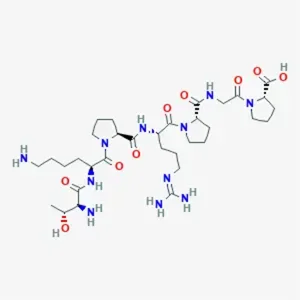
Introduction to Selank Acetate API: Selank Acetate API is a synthetic heptapeptide active pharmaceutical ingredient composed of the amino acid sequence Thr-Lys-Pro-Arg-Pro-Gly-Pro (TKPRPGP). Originally developed through neuropharmacological research...
View Details
Trusted Thymosin Beta-4 API Manufacturer and Global Peptide Supplier: As a professional Thymosin Beta-4 API manufacturer and supplier, we provide high-quality Thymosin Beta-4 peptide API solutions for biotechnology companies...
View Details
BPC-157 API is a synthetic pentadecapeptide that has gained increasing attention in peptide research due to its potential biological activities related to tissue repair, gastrointestinal protection, and angiogenesis...
View Details
With continuous development in neuroscience, peptide technology, and life science research, neuroactive peptides have become an important area of scientific investigation. Semax derived from ACTH fragment...
View Details
SS-31 API, also known as Elamipretide, MTP-131, Bendavia, is a synthetic mitochondria-targeting tetrapeptide designed to bind cardiolipin in the inner mitochondrial membrane, supporting cellular bioenergetics...
View Details


Explore our complete catalog of specialized pharmaceutical ingredients, custom reagents, and chemical intermediates.